Mixed Messages: The High Stakes of Social Sorting
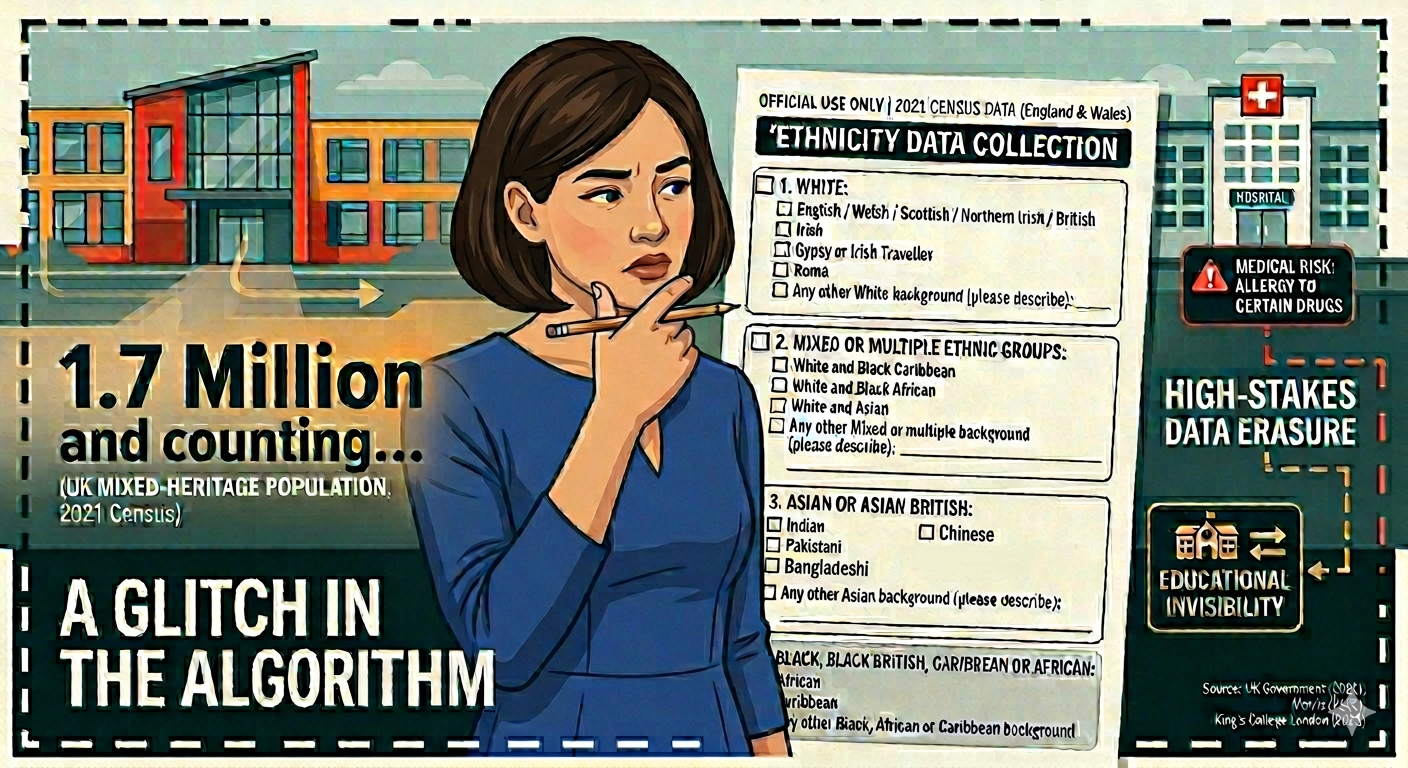
According to official statistics, the mixed-heritage population is now the UK’s fastest-growing demographic. The 2021 Census revealed that 1.7 million people across England and Wales identify as mixed-race, a tripling since 2001 (King’s College London, 2025).
Yet, in the eyes of a hospital computer or a school database, we are often reduced to a glitch. When our social sorting systems rely on a “White-plus” baseline, the messages aren’t just mixed — they’re dangerous.
The Challenge of the Checkbox
Supporting mixed-heritage children and young people in schools comes with a minefield of challenges. We are navigating outdated terminology, the complexities of identity development during adolescence, and fluctuating senses of belonging across different communities.
These journeys are often further complicated by orientalism, colourism, or a perceived “proximity to whiteness” — something that is not always a universal advantage.
To address this, we must first dismantle the social construct of “mixed-ness.” Until 2001, “mixed” categories didn’t even exist on the UK Census, making long-term data comparison nearly impossible. Even now, the categories remain stiflingly limited.
Society’s default stereotype of a mixed person is someone racialised as White and either Black or Brown. This is reflected in official data: almost every category begins with “White and…”, implying that Whiteness is the mandatory baseline. If you don’t fit that specific mould, you are relegated to the generic category: “Any other Mixed or multiple ethnic background.”
When Data Becomes a Danger
I experience this erasure personally. As someone of both Bangladeshi and Chinese heritage, I am frequently forced to choose: either to select one identity, or to select “Mixed Other.”
To pick one is to deny half of my identity. To pick “Other” is to make my heritage invisible.
Even when I attempt to claim both, the system often fails me. Alphabetised databases default my ethnicity to “Bangladeshi,” leaving my Chinese heritage effectively erased. In the eyes of the algorithm, half of my identity becomes a glitch.
This is not simply a matter of misrepresentation — it has real-world consequences. During an emergency operation while I was unconscious, my hospital record listed only my Bangladeshi heritage. As a result, the medical team were unaware of my Chinese ancestry, which carried a significant risk of a specific drug intolerance.
The Educational Blind Spot
In schools, ethnicity data is used to drive interventions, allocate funding, and analyse outcomes. However, as the proportion of mixed-heritage students continues to rise, our existing categories are becoming increasingly inadequate.
Because both of my heritages are broadly categorised as “Asian,” systems often fail to recognise me as mixed-heritage at all. Despite the cultural differences between Bangladeshi and Chinese identities, the “Asian–Asian” experience is frequently invisible within data systems that only recognise “mixed” where Whiteness is involved.
The result is a profound disconnect: an identity that is deeply felt, yet institutionally unrecognised.
A System in Need of a Reset
The issue extends beyond the category of “mixed.” For example, “Bangladeshi” is listed as an ethnicity, when it is, in fact, a nationality — one that has only existed since 1971. The conflation of nationality and ethnicity is a systemic issue in itself.
What this highlights is a deeper problem: our current methods of categorising people are outdated and insufficient.
We need a fundamental rethink of how we see, record and respond to identity in the UK today. We are more than a “White-plus” variable.
It is time for our systems to catch up with the complexity of the people they are meant to serve.
Pause and Reflect
How does your organisation currently categorise identity?
Who might be missing or misrepresented within your data?
What assumptions are built into the systems you rely on?
References
UK Government (2021) List of ethnic groups. Available at:
https://www.ethnicity-facts-figures.service.gov.uk/style-guide/ethnic-groups/
(Accessed: 21 April 2026)
Slade-Edmondson, E. (2026) What does it mean to grow up mixed-race…
https://www.thebelongingeffect.co.uk/...
(Accessed: 21 April 2026)
Mansaray, A. and Nwosu, C. (2025) Mixed-Heritage Young People’s Educational Experiences in London. King’s College London
https://www.kcl.ac.uk/ecs/assets/projects/mixed-heritage-final.pdf
(Accessed: 21 April 2026)
Morris, N. (2021) Mixed/Other: Explorations of Multiraciality in Modern Britain. London: Trapeze.